Datanami
 EnterpriseAI
 HPCwire Japan
 QCwire
 HPC & AI Wall Street
New GPGPU computing platforms are in the works at NVIDIA and AMD. Riding the success of the CUDA software platform, NVIDIA has partnered with a number of OEMs and system integrators to offer Tesla-equipped personal supercomputers. These machines offer as much as 4 single precision teraflops of performance for the cost of a high-end workstation. Meanwhile, AMD has released its most powerful GPU computing board, the AMD FireStream 9270, and has also partnered with Silicon Valley startup Aprius to offer a 9.6 teraflop GPU expansion chassis.
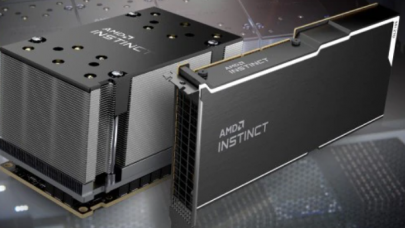
First AMD. On Nov. 13, the company unveiled the FireStream 9270, which is essentially a high-end version of the FireStream 9250, AMD’s original double-precision GPU card for HPC. By cranking up the clock speed on the GPU, the new offering boasts 1.2 single precision (SP) teraflops and 240 double precision (DP) gigaflops — 20 percent greater than the 9250. With 2GB of GDDR5 memory, the new board doubles the memory capacity and nearly doubles of bandwidth of its predecessor. And at 160W, the new 9270 runs just a tad hotter than the 9250.
The increased memory brings it back in line with the original FireStream 9170 board, but it still has just half the memory capacity of the latest Tesla gear from NVIDIA. Memory capacity is a big deal in GPU acceleration since if the dataset doesn’t fit in local memory, the runtime system has to spend time shuffling data bytes back and forth between the CPU host and the accelerator board. If the GPU ends up waiting for data from the host, this negates some of speedup realized by offloading computing onto the graphics chip.
Like the FireStream 9250, the 9270 uses a compact form-factor and can slide into both workstations and servers — anything with a PCIe 2.0 x16 slot. The new card will retail for $1,499, and will start shipping in a few weeks. If you happen to be in Austin, Texas, this week for the SC08 conference, you can see one in action at AMD’s booth.
AMD will also be demonstrating a FireStream-based expansion box, which will start shipping in early 2009. Built by newcomer Aprius Inc., the Computational Acceleration System (CA8000) is a 4U box that can hold up to eight 9270 GPU boards, yielding an aggregate performance of 9.6 SP teraflops (1.9 DP teraflops). Up to 4 PCIe x16 buses connect the box to host servers, using optical interconnect technology developed by Aprius. Since the connection is optical fiber, the expansion box can use the full speed of the PCIe bus over distances of up to 50 meters. It’s meant to offer a lot of compute density, along with the flexibility of a standard host connection. According to Patricia Harrell, AMD’s director of Stream Computing, they’ve received a lot of interest from both end users and the tier one OEMs.
NVIDIA has no new Tesla gear lined up for SC08 this week, but the company has come up with a hardware reference platform that can be used to build Tesla-equipped personal supercomputers. Of course, researchers have been cobbling together GPU-accelerated workstations for awhile, but until now, users had no productized GPGPU desktop option other than PCs and workstations equipped with CUDA-compatible GPUs.
NVIDIA’s strategy seems to be to stake out the middle of the market between workstations and PCs sequestered for GPU computing and full-blown Tesla-accelerated clusters, like the 170 teraflop system just announced by Tokyo Tech. The Tesla personal supers can be used as development and test platforms for Tesla clusters or as HPC production systems in their own right.
Since the NVIDIA reference platform specifies multiple GPUs, a Tesla desktop system will be much more powerful than a single-GPU workstation. The minimum configuration for a Tesla-equipped personal supercomputer includes a quad-core CPU, 3 to 4 C1060 boards (each with a 10-series GPU), and 4 GB of memory per GPU. That would yield a machine capable of 4 SP teraflops and 400 DP gigaflops. These personal systems should retail for around $10,000. According to Sumit Gupta, senior product manager at NVIDIA, the new Tesla-equipped machines will be “to supercomputing what PCs are to computers.”
NVIDIA believes the personal supercomputer market is around 15 million researchers, nearly 6 million of which are in the US alone. Certainly, many HPC stalwarts think GPUs have earned their place in the supercomputing ecosystem. Jack Dongarra at the University of Tennessee said that GPUs are now suitable for real-world application adding: “Future computing architectures will be hybrid systems with parallel-core GPUs working in tandem with multi-core CPUs.” Microsoft’s Burton Smith is convinced that desktop supercomputing is for real this time around, noting that “[h]eterogeneous computing is what makes such a breakthrough possible.”
NVIDIA has managed to attract some notable vendors, including Dell, Penguin Computing, Colfax International, Western Scientific, BOXX, Lenovo, ASUS, and a number of others. The desktop offerings will be sold under their respective brands, but NVIDIA will direct potential customers to its partners via its own Tesla Web site.
It’s interesting to see players that are relatively new to HPC, like ASUS and Lenovo, now offering personal HPC systems. In October, I reported that high-end PC maker Velocity Micro (also a launch partner for NVIDIA) had introduced its Tesla-equipped personal system. At the time, I wondered if other desktop vendors would jump into the GPGPU fray. I guess I have my answer.