Datanami
 EnterpriseAI
 HPCwire Japan
 QCwire
 HPC & AI Wall Street
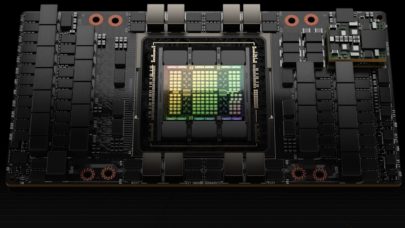
GPU maker NVIDIA has ratcheted up the core count and clock speed on its Tesla GPU processor. The new M2090 module for servers delivers 665 double precision gigaflops, representing close to a 30 percent increase over the previous generation Tesla part. The memory bandwidth on the device was bumped up as well, from 150 GB/second to 178 GB/second. The new GPU boosts performance significantly across a number of HPC codes.
The big change for the new GPU is the additional CUDA cores — from 448 on the previous generation M2070, to 512 on the M2090. The Fermi (20-series) GPU design was spec’d from the beginning to hit 512 cores, but in the original version only managed to reach 448.

According to Sumit Gupta, NVIDIA’s senior product manager for the Tesla group, that was because the original Fermi layout and 40nm process technology from chip manufacturer TSMC (Taiwan Semiconductor Manufacturing Company) could only accommodate the lesser core count at the power envelope they were comfortable with, which in this case was 225 watts. With a tweaked processor design and an optimized 40nm process, NVIDIA and TSMC were able to get the full 512 cores on the new chip. In addition, there was enough thermal headroom to crank up the GPU clock from 1.15 GHz to 1.30 GHz.
Likewise, a faster clock on the memory side accounted for the jump in bandwidth there. In this case, they increased the speed from 1.56 GHz to 1.85 GHz, boosting bandwidth to and from the local GDDR5 memory by nearly 19 percent (from 150 GB/second to 178 GB/second). That’s a nice bump, especially for codes that are sensitive to the memory bottleneck.
The speedier M2090 managed to deliver between 20 to 30 percent more performance on a number key technical computing codes, compared to running the software on the previous M2070 hardware. These include 25 percent faster execution for Linpack, 20 percent for Kirchoff time migration (oil and gas), 30 percent for Wang-Landau/LSMS (material science), 20 percent for SIMULIA’s Abaqus FEA (manufacturing), and more than 22 percent for AMBER (molecular dynamics/life science).
AMBER, a widely used code to for biomolecular simulations, got an extra GPU performance boost with additional optimization on the software side. According to NVIDIA, the combo of faster hardware and software enables researcher to use just four GPUs to perform simulations that until recently required a good-sized CPU-based cluster or supercomputer.
A quad-M2090 system, encapsulated in just one or two servers, can deliver 69 nanoseconds of biomolecular simulations per day. (Last September at the GPU Technology Conference, NVIDIA reported than an IBM iDataPlex cluster with eight GPUs achieved 52 ns/day with AMBER.) While that might not seem like the swiftest execution for molecular twiddling, it represents the high water mark for AMBER simulations on any machine, supercomputer or otherwise. The result is that scientists with a only a departmental sized budget can buy their own system that runs AMBER at levels that used to only be possible at national labs.
In fact, getting four graphics devices in a single server is relatively easy nowadays. OEMs like Appro, ASUS, and HP all offer such GPU density, with HP’s ProLiant SL390 G7 (of TSUBAME fame) available with up to eight GPUs and two CPUs in a half-width 4U tray. With the latest M2090 hardware now available in the SL390 G7, organizations of relatively modest means can build a 100-teraflop system that fits into a single rack.
That steeper GPU:CPU ratio, exemplified by the HP gear, is becoming more commonplace says NVIDIA’s Gupta. “As more and more applications start taking advantage of GPUs and those applications become more optimized for the GPUs, I think the density of GPUs to CPUs is going to keep increasing,” he told HPCwire.
Also, as CPU core counts rise, there is less of a need for multiple CPUs in a server if the end use is exclusively for heavily GPU-accelerated applications. Given that one CPU core can drive a GPU device, a single six-, eight- or 12-core x86 processor may be all that is required for such codes.
All the OEMs with a GPU offering using NVIDIA’s M20xx devices are expected to move up to the new M2090. Besides HP, that includes IBM, SGI, Bull, Appro, ASUS, Supermicro, NextIO, and Tyan. The M2090 may also be the hardware going into the upcoming GPU-equipped variant of the Cray XE6 supercomputer, scheduled for launch later this year. Although I speculated last week that this machine might get NVIDIA’s next-generation Kepler GPU, the fact that NVIDIA just released its Tesla kicker probably indicates at least a six-month wait for the next product. In any case, since Kepler will land on TSMC’s 28nm process node, NVIDIA will have to wait until that fab technology is mature enough to handle complex, multi-billion transistor designs.
All of that means Kepler will most likely launch sometime in the first half of 2012. Until then the new Fermi-class M2090 will be carrying the HPC load for the GPU maker. Although theoretically, NVIDIA could tweak the Tesla GPU one more time; with the next-generation architecture just over the horizon, there is probably little motivation to do so. “We’re looking to Kepler now,” says Gupta.