Datanami
 EnterpriseAI
 HPCwire Japan
 QCwire
 HPC & AI Wall Street
Nimbus Data Systems has unveiled its second-generations flash storage system, promising three times the performance and expanded networking options The new S-Class systems will be offered at the same $10,000/TB price as the first-generation product, which was introduced last April. Since then the company has sold dozens of systems, including a 100 TB deployment at eBay.
In 2010, when many storage companies were in introducing flash-disk hybrid products, Nimbus blazed the trail with its flash-only S-Class storage platform. According to Nimbus CEO and founder Thomas Isakovich, a year ago most customers were only deploying flash selectively for “hot data.” Now, he says, they’re starting to see flash being used for primary storage in the datacenter, especially at the performance end of the spectrum, where 15K SAS and Fibre Channel disk-based systems are entrenched. “The disk drive has been a great thing for the last couple of decades,” says Isakovich, “but it’s not longer cutting the mustard when it comes to what organizations need to do today.”
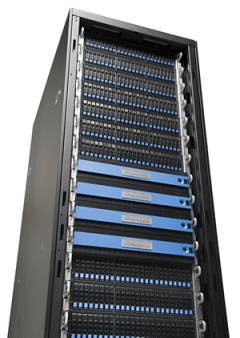 Nimbus’ S-Class is aimed squarely at storage customers looking for more I/O performance, but not willing to spend exorbitantly to get it. At the $10,000/TB price point, the company claims its gear is comparable in price to disk-based 15K systems, while saving significantly on power consumption (80 percent better) and maintenance costs (50 percent better). And thanks to the flash technology, compared to 15K technology, the S-Class delivers about 52 times better IOPS, 21 times better I/O bandwidth, and 75 times better latency on a cost basis. A single S-Class 2U chassis draw just 100 watts, but is able to deliver the IOPS equivalent to more than 2,000 15K drives, which would draw 37 KW and take up about 8 racks.
One way Nimbus is able to level the playing field in acquisition costs is by using Micron’s Enterprise Multi-Level Cell (EMLC) NAND, a variety of flash that is ten times as durable as consumer-grade MLC, but at a about a quarter of the price of enterprise Single-Level Cell (SLC) NAND. Even at that though, the total hardware cost per TB for an S-Class shelf is about twice that of a 15K disk box.
The difference is made up in software and maintenance costs. Isakovich says that the inclusion of their HALO operating system at no additional cost means customers don’t cough up additional money for software licensing, which in traditional storage systems can represent half the system price. HALO incorporates a full software stack for enterprise-grade storage, including goodies like unified SAN and NAS capability, snapshots, deduplication, replications and high availability features, among others. Also since flash is inherently more reliable (less heat, no mechanical failures) than disk, support costs are much less.
All told, Nimbus pegs total acquisition costs of its gear at 12,650/TB versus $13,200/TB for a 15K system. And since power, cooling, and maintenance for their flash systems are just a fraction of that of a disk-based system, Nimbus feels like there is nothing to prevent it from it’s pushing their SAS and FC competition out of the market. “We are really taking down 15K disks in the datacenter,” declares Isakovich.
That doesn’t mean hard disks will be relegated to the dust heap just yet. SATA disk technology is much less expensive on a cost per TB basis than either 15K drives or flash. So for situations were capacity is the driving factor, Nimbus expects SATA to retain its edge for the foreseeable future.
But that still leaves a big chunk of the market open to Nimbus. The S-Class platform purports to address all the major enterprise sectors, including virtualized storage, databases, HPC, and the cloud. The 100 TB eBay installation announced this week represents the first of what Nimbus hopes is many such proof points for its technology. In this case, 12 first-generation S-Class systems were installed to speed up the company’s VMware virtual server infrastructure. The goal was to be able to deploy standard storage “pods” for its virtualization needs.
That’s not even necessarily the company’s biggest deployment though. Isakovich says there is a some somewhat larger installation of S-Class systems installed by a government agency that wishes to remain anonymous. Like eBay, they too have bought over 100 TB of Nimbus flash.
The second generation S-Class has the same capacity as last year’s model — available in 2.5, 5.0 and 10 TB shelf units, which can be stacked to make a system up to 250 TB — but exceeds the original in almost every other metric. For example, the new version increases the internal bandwidth by a factor of six and delivers up to 800,000 IOPS per shelf (up to 16 million IOPS per rack). Internally they jacked up the flash interface from 3 Gbps to 6 Gbps to get full line-rate to every NAND module.
Networking has been expanded as well to take advantage of the better internal performance. While the original only supported GigE and 10GigE connectivity, the new systems are available with up to 8 ports of 8 GBps Fibre channel or 8 ports of QDR InfiniBand. The latter is especially noteworthy for HPC storage, where it is still relatively rare to have native InfiniBand connectivity.
The nod toward high performance computing with InfiniBand support is a key aspect of Nimbus’ market strategy. Although most of the S-Class sales to date have come from the enterprise customers, they have “a handful” of deployments in HPC verticals like oil and gas, financial services, life science, and education. Isakovich thinks there’s a lot of upside in this area. According to him, whereas the average enterprise customer will buy two or three S-Class boxes, an HPC customer will buy dozens. “I think there is really the potential for explosive growth there,” he says.