Datanami
 EnterpriseAI
 HPCwire Japan
 QCwire
 HPC & AI Wall Street
It has been a little over three years since IBM’s Roadrunner supercomputer gained the distinction of first to crack the petaflop barrier and over 15 years since the ASCI Red broke the teraflop mark. Assuming that advancements in technology continue as expected, the exaflop line should be crossed roughly around the year 2018.
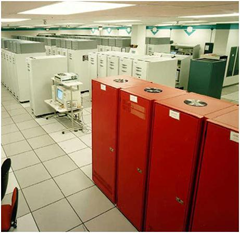 One factor that seems to be the main roadblock on the path to exascale computing is power consumption. Let’s take for example the ratio of power consumed between the ASCI Red and IBM’s Roadrunner. According to the TOP500 list, the ASCI Red broke the teraflop barrier consuming 850 KW of power and the IBM Roadrunner hit the petaflop mark while using 2,483 KW. So along with the advancements in technology between 1996 and 2008, the ratio of processing power/watt increased.
Since the exascale barrier has not been broken, let’s turn to the number one supercomputer on the TOP500 list, Japan’s K computer, which has recently crossed the 10 petaflop mark, and uses 12,659 KW of power. Compared to the first petaflop supercomputer, the K machine consumes more than 5 times the wattage to deliver just 10 times the processing power. Although this is an improvement over installing 10 Roadrunner supercomputers to achieve the same amount of processing power, it’s quite far off the mark from the teraflop/petaflop gap in wattage.
So maybe the answer to exaflop computing is advancements in the processor manufacturing process, processor management, and certainly system design. A traditional driver for supercomputer advancements has been DARPA, who has been funding the Ubiquitous High Performance Computing (UHPC) for the past couple of years. While UHPC is not explicitly aimed at designing exascale systems, it certainly is targeting technologies that are applicable to such machines.
But according to a recent article by Indiana University’s Thomas Sterling in The Exascale Report, it is likely that the UHPC program will not extend beyond its first phase. The original idea was to fund four phases, the last of which would have produced a proof-of-concept platform. The DOE may be the agency that takes up the exascale slack, but Sterling is clearly worried about the lack of will by policy makers to support such work.
Internationally, there does seems to be momentum building behind the exascale push. Sterling mentions both the International Exascale Software Project (IESP) and the European Exascale Software Initiative (EESI), as important programs to move the ball forward. The EESI is notable inasmuch as is does not depend upon a leading role from the US.
Asia, too, seems to have struck out on its own. Sterling is impressed that the Japanese, with the K computer, have managed to produce an original architecture that, for the time being, leaves the competition in the dust. He also expects to see similar originality from the Chinese, who appear to be committed to deploying cutting-edge supercomputers, designed and built domestically.
Sterling’s advice at this point is that the US should team up with the international community for the good of HPC. Given that financial resources, talent, and good ideas are now more globally distributed than they were in the run up to terascale and petascale computing, this may be the most practical way forward. “The US may not own the Exascale space,” concludes Sterling.