Oakridge Top Right
HPCwire

Since 1986 - Covering the Fastest Computers
in the World and the People Who Run Them

Language Flags

Visit additional Tabor Communication Publications

Datanami
Digital Manufacturing Report
HPC in the Cloud
Green Computing Report

Tabor Communications
Corporate Video

Kepler GPU Makes Quick Work of Quicksort


NVIDIA is once again highlighting some the Kepler hardware goodies that will come with the K20 chip, which is due out later this year.  A blog post penned by NVIDIA engineer Stephen Jones, discusses the new 'Dynamic Parallelism' feature of the K20, a processor aimed at the supercomputing market.

Dynamic Parallelism enables an application task (called a stream, in GPU parlance) to spawn other tasks inside the GPU.  The feature is supported by the presence of a "grid management" unit on the chip that allows tasks to be launched, suspended and resumed natively. Prior GPUs forced the application to return control to the CPU host to start up another kernel task. Essentially this allows more of the application to execute continuously within the GPU without having to bounce back to the CPU.

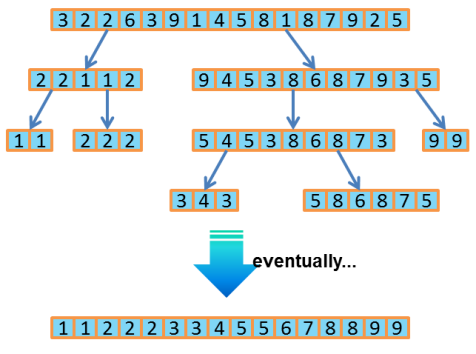
Jones illustrates how this works with the classic Quicksort program. Basically Quicksort slices up a list of items into sub-lists, and sorts them individually.  As Jones writes," It’s a classic 'divide-and-conquer' algorithm because it breaks the problem into ever smaller pieces and solves them recursively."


Prior to the K20 Kepler, the GPU would have had to return control to the CPU for each sub-list sort, and the application code would have to manage that back-and-forth rather inelegantly. With dynamic parallelism, the CUDA code is short and sweet, resembling a standard CPU-type implementation.

Not only should this make the programming the application more natural, but it also should increase performance since it eliminates much of the communication and context switching between the CPU and GPU. Also, since the grid management unit enables the tasks to be run concurrently on different parts of the GPU, even more performance can be extracted. Plus, it leaves more of the CPU free to do its own work, which can speed overall execution even further.

Any type of application that uses these divide-and-conquer algorithms can take advantage of this feature. It includes things like  branch-and-bound algorithms, graph analytics, and adaptive meshing, to name a few. That encompasses a wide range of common HPC apps: CFD, mechanical stress analysis, weather codes, computational ray tracing -- actually the list is rather large.

The only real disadvantage is for existing CUDA codes that were developed on pre-K20 GPUs. In these cases, the programs would have to be tweaked to take advantage of the new feature. For developing or porting new codes, this feature looks to be a no-brainer.


Full story at NVIDIA website

June 18, 2013

June 17, 2013

June 14, 2013

June 13, 2013

June 12, 2013

June 11, 2013

June 10, 2013

June 07, 2013

June 06, 2013


Most Read Features

Most Read Around the Web

Most Read This Just In


Feature Articles

My Supercomputer is Bigger Than Yours!

Contributing commentator, Andrew Jones, offers a break in the news cycle with an assessment of what the national "size matters" contest means for the U.S. and other nations...
Read more...

Alternatives Emerge as Linpack Loses Ground

Today at the International Supercomputing Conference in Leipzing, Germany, Jack Dongarra presented on a proposed benchmark that could carry a bit more weight than its older Linpack companion. The high performance conjugate gradient (HPCG) concept takes into account new architectures for new applications, while shedding the floating point....
Read more...

Intel Snaps New Grips to HPC Hook

Not content to let the Tianhe-2 announcement ride alone, Intel rolled out a series of announcements around its Knights Corner and Xeon Phi products--all of which are aimed at adding some options and variety for a wider base of potential users across the HPC spectrum. Today at the International Supercomputing Conference, the company's Raj....
Read more...

Sponsored Whitepapers

Best Practices in Big Data Storage

05/10/2013 | Cleversafe, Cray, DDN, NetApp, & Panasas | From Wall Street to Hollywood, drug discovery to homeland security, companies and organizations of all sizes and stripes are coming face to face with the challenges – and opportunities – afforded by Big Data. Before anyone can utilize these extraordinary data repositories, however, they must first harness and manage their data stores, and do so utilizing technologies that underscore affordability, security, and scalability.

Progress in Parallel: the Bull Parallel Programming Center

04/15/2013 | Bull | “50% of HPC users say their largest jobs scale to 120 cores or less.” How about yours? Are your codes ready to take advantage of today’s and tomorrow’s ultra-parallel HPC systems? Download this White Paper by Analysts Intersect360 Research to see what Bull and Intel’s Center for Excellence in Parallel Programming can do for your codes.

Sponsored Multimedia

HPCwire Live! Atlanta's Big Data Kick Off Week Meets HPC

Join HPCwire Editor Nicole Hemsoth and Dr. David Bader from Georgia Tech as they take center stage on opening night at Atlanta's first Big Data Kick Off Week, filmed in front of a live audience. Nicole and David look at the evolution of HPC, today's big data challenges, discuss real world solutions, and reveal their predictions. Exactly what does the future holds for HPC?

Webinar: Mellanox Virtual Modular Switch, the Most Efficient 40GbE Aggregation Switch Solution

Join our webinar to learn how IT managers can migrate to a more resilient, flexible and scalable solution that grows with the data center. Mellanox VMS is future-proof, efficient and brings significant CAPEX and OPEX savings. The VMS is available today.

Atlanta's Big Data Kick Off Week Meets HPC Cray

HPC Job Bank


Featured Events


  • November 17, 2013 - November 22, 2013
    SC'13
    Denver, CO
    United States


HPCwire Events