Datanami
 EnterpriseAI
 HPCwire Japan
 QCwire
 HPC & AI Wall Street
Dell has launched a new line of servers aimed at “hyperscale” server setups. The PowerEdge C8000 series encompasses a shared infrastructure chassis that can mix and match three different flavors of servers: vanilla x86 CPU, coprocessor-accelerated, and high density storage. The new offering will be the basis for Stampede, the 10-petaflop supercomputer being built this year at The Texas Advanced Computing Center (TACC).
The PowerEdge C8000 represents Dell’s latest hyperscale servers, what are sometime called “density optimized” servers. They encompass blade systems and other multiple-server chassis setups. The C8000 falls into the latter category, resembling blades in its ability to support a shared server infrastructure, but without some of the bells and whistles such as redundancy, system management, and shared network I/O.
As such, this is not really aimed at traditional enterprise computing, but rather hyperscale environments, such as HPC, Web 2.0, and cloud computing (including, now, Hadoop-style big data apps), where maximizing compute and storage performance is paramount. Density optimized systems represent a big growth area for server makers, and most especially for Dell. Lately the company has done rather well for themselves in this category, garnering a 50-plus-percent market share, according to IDC.
With the C8000, Dell is looking to capitalize on that growth, using the latest chipsets and tweaking the architecture to max out on performance and storage per cubic meter. A 4U chassis is capable of housing up to eight single-width or four double-width “sleds” (Dell’s nomenclature for its shared infrastructure mini-blades), which slide vertically into the enclosure. Two extra sled slots are available for the power supplies.
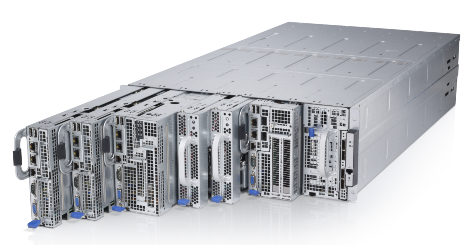
There are three C8000 model in the series:
1. PowerEdge C8220: A single-width compute sled, with dual-socket Xeon E5-2600 (“Sandy Bridge”) CPUs, up to 256GB of memory, and a SATA port for a spinning disk or SSD.
2. PowerEdge C8220: A double-width compute sled, with the same CPU and memory set-up as the C8220, but with the addition of PCIe-based compute accelerators, in this case, either an NVIDIA Tesla GPU or a Xeon Phi (when available). Support for AMD FirePro GPUs is in the works. Two accelerators per sled can be accommodated.
3. PowerEdge C8000XD. A double-wide storage sled that can house up to 36TB of storage. It can be configured with 12 x 2.5” or 3.5” SAS/SATA drives or 24 x 2.5” SSDs. Everything is hot-pluggable.
Mixing and matching sled types in the chassis offers a lot of flexibility as far as balancing compute and storage capacity. Since the latest x86 CPUs and GPUs are supported, a chassis can deliver over 5 teraflops. (When Intel’s Xeon Phi and NVIDIA’s K20 GPU become available in few months, that should easily double.) On the other hand, maxing out storage will get you 144TB per chassis. And by the end of the year, Dell will offer an external power setup, which will free up the two power slots for even more compute and storage.
TACC’s Stampede supercomputer is Dell’s first public win for the C8000, and will include both storage and compute sleds. It will make particular use of the C8220X, incorporating the upcoming Intel Xeon Phi coprocessors and NVIDIA Kepler GPUs. The whole system is 10 petaflops (peak), but most that — 8 petaflops — is coming from the Xeon Phi silicon.
All told, there will close to 200 racks of Dell gear, spread out over about 10,000 square feet of floor space. Power draw is expected to be in the neighborhood of 5 megawatts, which is near tops in energy efficiency for a petascale cluster.
As it turned out, the C8000 was the right combination of feature set, energy efficiency and density required by TACC for the Stampede project. According to Brian Payne, Dell’s executive director of PowerEdge Servers, they beat out both HP and Appro for the contract. Both had systems with GPU and Xeon Phi support, but neither one provided the high-density storage modules present in the Dell offering. “The reason we won is that we could do it all in one form factor, whereas our competition couldn’t,” said Payne.
The entire C8000 product line is available for shipment this month. Stampede is currently under construction and is expected to go into production in January 2013.