Datanami
 EnterpriseAI
 HPCwire Japan
 QCwire
 HPC & AI Wall Street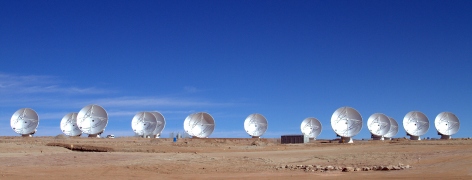
A new petascale supercomputer built to study the universe is one of the fastest calculating machines in the world, and certainly the fastest of its kind. The supercomputer is part of ALMA, a new radio telescope that is claimed to be “largest ground-based astronomical project in existence.”
ALMA, which stands for Atacama Large Millimeter/submillimeter Array, is an international project, which includes partners from Europe (European Southern Observatory, Laboratoire d’Astrophysique de Bordeaux), North America (National Radio Astronomy Observatory), and Japan (National Astronomical Observatory of Japan). The Joint ALMA Observatory, based in Santiago Chile, manages the project.
The ALMA radio telescope is a collection of 66 high-precision antennas (parabolic dishes that act as receivers), strewn over the 5,000 meter-high Chajnantor desert plateau in northern Chile. The dry air and elevation makes it a particularly suitable spot for capturing signals from space in the millimeter and sub-millimeter radio spectrum. At those wavelengths, the antennas can detect the so-called “cool Universe,” molecular gas and dust as well as residual radiation from the Big Bang.
The antennas can be set to capture signals in a variety of configurations, such that the distance between them can vary between 150 meters to 16 kilometers. That gives the ALMA telescope something akin to a “zoom” capability, as well as very high sensitivity and resolution. As a result, it should be able to produce images 10 times sharper than that of the Hubble Space Telescope.
The challenge of multiple radio antennas is to make them behave as a single receiver, and for that you need some hefty number crunching — thus the need for a supercomputer. The one built for ALMA is actually a special-purpose device designed to correlate faint signals from multiple sources. Because of its function, the supercomputer is actually known as “the correlator.” The supercomputer jargon was added later by the public relation guys to bring attention to its exceptional calculating prowess.
And exceptional it is. The correlator deliver 17 quadrillion operations per second. That’s 17 petaOPS (not petaFLOPS). If you discount these are not floating point operations, the system operates at a level comparable to Titan, the fastest general-purpose supercomputer in the world, and the current title-holder on the TOP500.
The ALMA system, which was built by the National Radio Astronomy Observatory (NRAO), uses 32,767 custom ASIC processors to blend the signals from the antenna array. The processors, built on 0.25 micron CMOS technology, run at a modest 125 MHz, with each one drawing just 1.8 watts. But because it is purpose-built for these correlation functions, the silicon is able to deliver 512 billion operations per second (gigaOPS). The processors are arranged 64 to a board, which are connected via a 1 megabit/second Controller Area Network.
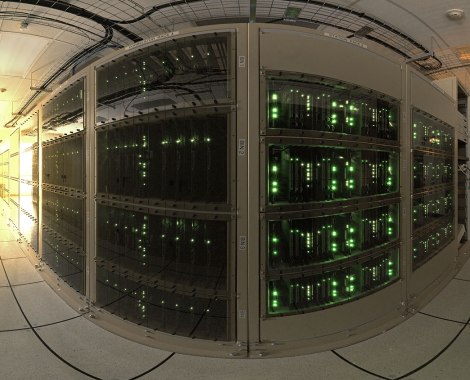
There are also 17 ancillary computers involved in acquiring and calibrating data from the correlator hardware. The correlator itself is designed to receive 96 gigabits per second from up to 64 antennas and can sustain an output rate of 1 gigabyte per second.
The supercomputer is not all hard-wired though. According to Rich Lacasse, leader of the ALMA Correlator Team at NRAO, and Joe Greenberg, who worked on the hardware, there are several layers of software. For example, the processor supports about 70 flavors of correlation functions each with programmable features. So coding is required to configure these modes as well as monitor for correct operation. There is also high-level software for configuring the processors.
The proprietary architecture of the correlator was used to overcome cost and power usage constraints of the ALMA project. John Webber, former head of the NRAO Central Development Laboratory, says despite the custom design, their system was built for just $11 million, adding that a comparable general-purpose computer would have cost about $1 billion. Actually a GPU-accelerated supercomputer is quite a bit less expensive these days. Titan, for example, was built for $100 million. Nevertheless, that’s still nearly 10 times the cost of the ALMA machine.
Energy efficiency is even more impressive. Thanks to the low-power processors, the correlator consumes just 140 kilowatts of power. (The general-purpose Titan draws 8 megawatts.) But despite the correlator’s modest power usage, it takes twice the normal airflow to cool it due to the rarified atmosphere at 5,000 meters (16,500 feet). Also, hard drives operate problematically in the thin air, so the correlator is diskless.
ALMA began collecting data in 2011 with a partial array of radio antennas, with a cut-down version of the correlator being used to combine the signals from the initial array. Today, though, the entire array is operational and the correlator is ready for begin slicing and dicing signals from a larger number of antennas. That will increase its sensitivity and resulting image quality. The project is slated to be completely operational in March 2013.