Datanami
 EnterpriseAI
 HPCwire Japan
 QCwire
 HPC & AI Wall Street
The Office of Fossil Energy’s National Energy Technology Laboratory (NETL) is the proud owner of a brand new SGI supercomputer. Named High-Performance Computer for Energy and the Environment, or HPCEE for short, the 500 teraflops machine will help NETL scientists undertake a broad range of energy and environmental research, with a focus on coal, natural gas and oil.
 Growing concern over climate change has led many to reconsider our relationship with fossil fuels, which comprise nearly 60 percent of human-generated CO2 emissions. The reality is that for now, traditional energy sources continue to dominate US energy policy, but there are signs of change. The US Department of Energy (DOE) under the direction of outgoing-Secretary Steven Chu has pushed for an environmentally-sound, sustainable energy portfolio that includes alternative energy sources. It was Chu who set the stage for some of NETL’s most prominent programs, for example the Simulation-Based Engineering User Center (SBEUC) and the Carbon Capture Simulation Initiative (CCSI).
As a Department of Energy lab, NETL supports the DOE’s mission to advance the national, economic, and energy security of the United States, mainly through a focus on fossil fuel resources. A glance at the lab’s key mandates – which include clean power, climate change mitigation, energy-efficiency and renewable energy – reveals an expanded awareness of today’s energy-related challenges. One of the ways that NETL contributes to climate change mitigation is by developing new methods for monitoring, capturing and sequestering greenhouse gases as directed by the President’s Global Climate Change Initiative. High-performance computing is essential to carrying out this research.
 HPCwire spoke with Chris Guenther, director of NETL’s Computational Science Division to find out more about the new system. Mr. Guenther is responsible for the day-to-day management of NETL’s Simulation-Based Engineering User Center – where HPCEE is housed.
“Within the division what we try to do is develop physics-based models and methods and tools to accelerate the development and deployment of advanced technology to utilize our fossil energy resources,” says Guenther.
His team undertakes a wide range of modeling and simulation work at various scales, from molecules to devices to entire power plants.
HPCEE was commissioned to support the computational fluid dynamics and computational chemistry efforts underway at NETL. The SGI Rackable machine contains 24,192 2.6 gHz Intel Xeon E5-2670 cores with 48,384 GB of system memory in 1,512 computational nodes connected via Mellanox InfiniBand QDR. The architecture achieved 413.5 teraflops Rmax (Linpack) out of 503.2 teraflops peak, for an impressive theoretical efficiency of 82 percent.
NETL characterizes HPCEE as one of the most energy-efficient systems of its kind in the world, but that statement merits closer inspection. The half-petaflop supercomputer placed a respectable 55th on the latest TOP500 list. But on the Green500 list, which ranks top systems based on FLOPS per watt, the system finished in 403rd place – not exactly boast-worthy.
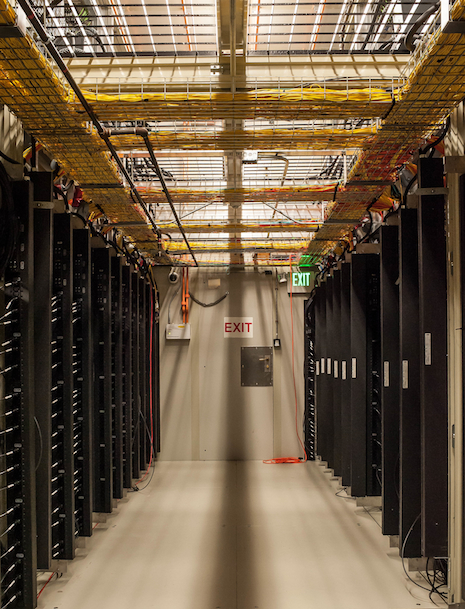
Where NETL can claim some green bragging rights is on the datacenter-side. HPCEE resides inside an SGI ICE Cube Air datacenter, which provides cooling and power with a PUE in the 1.03 to 1.06 range. It does so “out-of-the-box” – no special modifications were made to achieve this level of performance.
This low PUE reading means that only one percent of total electrical consumption goes toward cooling the equipment. NETL notes that the increased efficiency translates into an average annual savings of $450,000.
“The SGI Modular Data Center consists of a 1.1 MW transformer and utility/power center supporting two equipment aisles of 20 racks each,” says Guenther. “Three racks of storage and utility equipment, three racks of Mellanox trunk switches and 21 racks of compute nodes fill 27 of the available racks.”
Asked what the impetus was for a modular datacenter as opposed to a custom-built site, Guenther referenced a site study which showed that the external modular datacenter approach was more cost effective and quicker in terms of providing compute cycles to the Fossil Energy research staff. The purchase decision was based on a scoring system which put an emphasis on performance and efficiency, he reported.
This 500-teraflops machine is a really big deal for NETL researchers and their partners. Up to now, the laboratory has gotten by with using many small computer clusters, but there were many days when users simply could not find available cores to do their work, notes Guenther. With an order of magnitude more computing power, scientists will have more cores available to them and they’ll be able to model extremely difficult problems, such as coal jet penetration into a gasifier.
 As HPCEE comes online, they will start shutting down the other clusters except for one or two, adding to the overall energy savings.
While most of NETL’s funding and work is to support the Office of Fossil Energy, Guenther emphasizes an R&D portfolio that is “weighted heavily toward technology that is much more environmentally-friendly as well as the optimization of existing fossil energy devices.”
“Fossil energy gets a bad rap, but just about everything that we are doing is focusing on the environmental aspect of fossil energy,” he adds.
Underscoring this point, Guenther cites the innovative work of the Carbon Capture Simulation Initiative (CSSI), tasked with accelerating the development and deployment of sorbent-based CO2 capture. This NETL-led project just rolled out a suite of 21 computational tools and models aimed at new carbon capture technologies.
“Programs like this are the reason we have HPCEE,” says Guenther. “The high fidelity computational fluid dynamic modeling work that is part of the Carbon Capture Simulation Initiative will be done exclusively on this new system.”
 |
|
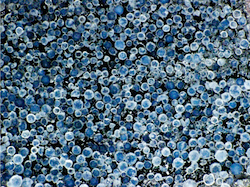
| Sorbent pellets developed by NETL prepared by Pressure Chemical Company | |
“There’s no commercial-scale sorbent-based carbon capture systems out there,” he continues. “We’re developing our own sorbents here at NETL from the ground up. We’re testing those; we’re modeling them in small reactors; we’re gaining confidence in our models that will allow us then to scale up these models, to actually look at the ability in the virtual world to do commercial-scale sorbent-based CO2 capture.”
For industry, sophisticated models like these are critical for reducing the risks associated with commercialization.
Combining innovative technology with an effective industry transfer mechanism is a winning strategy. NETL was just recognized by R&D Magazine for its work with sorbent pellets. The magazine considers this novel carbon capture technology among the 100 most technologically significant products to enter the marketplace within the past year.
The CCSI also helps quantify the uncertainty associated with a model’s prediction. “In this initiative, they’re conducting models at different length and time scales,” says Guenther. “At one end they’re doing process-level modeling, or the overall power-plant type modeling. At the other end, they’re doing very high-fidelity, kinetic models and CFD models that are very small length of time scales, and they’re coupling those different models together in a consistent fashion and they are propagating the uncertainty through these different length and time scales.”
NETL projects span the entire gamut of research stages. “We work with industry and other people on brand-new technology that has not hit the ground as well as technology that’s already out there that we are trying to optimize and/or improve,” says Guenther.
As an example of the former, the lab is exploring promising new technologies like chemical-looping, which offers the potential to generate electricity from coal with significantly less pollution and less cost. To do this, researchers are building models and gaining insight from a fundamental level using small experiments to help guide them.
And at the other end of the spectrum, NETL scientists are doing work with coal gasification, a technology that is more mature and which they have more experience with. This is an area where they are applying their models toward industry transfer and commercialization.
The HPCEE support staff are currently in the process of migrating over data, software and all the necessary tools for performing day-to-day simulations. They anticipate that the system will be production-ready by early Spring.
When HPCEE goes live, researchers from the five universities that are part of the NETL-Regional University Alliance – Carnegie Mellon, Penn State, the University of Pittsburgh, West Virginia University, and Virginia Tech – will also be able to access the supercomputer.
Related Articles
Steven Chu’s DOE Legacy: Big Science, Grand Challenges and Solyndra
New Computational Tools Help Carbon Capture Technologies
Clean Energy Conundrum: In Europe, Regulations Have Helped Create a “Golden Age Of Coal”