Datanami
 EnterpriseAI
 HPCwire Japan
 QCwire
 HPC & AI Wall Street
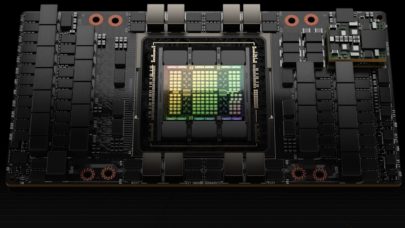
NVIDIA has announced two new Tesla-branded GPU computing products at ISC’08, continuing the company’s efforts to move into the HPC market. The new products are based on NVIDIA’s next generation 10-series GPU processor architecture. The T10P processor unveiled today offers double precision float point support, more local memory, plus much higher overall performance. NVIDIA is touting the new 10-series chip as the second generation processor for CUDA, the company’s GPU computing development platform.
The T10P, which is built on 55nm process technology, doubles the capability of the previous generation Tesla offerings, which were based the 8-series NVIDIA architecture. The new GPU has twice the FP precision (32-bit to 64-bit) and the raw compute performance (500 gigaflops to 1 teraflop). It’s important to note that the teraflop figure is single precision performance; double precision performance is delivered at a much more modest 100 gigaflops.
Each of the 240 cores in the T10P is implemented as a “thread processor” with an integer unit, floating point unit, and a register file. Eight thread processors are arranged in a thread processor array, which shares a special functions unit (transcendental and other functions) a double precision (DP) floating point unit, and 16KB of shared memory that works at cache speed. Except for the DP unit, the design is the same as the NVIDIA’s 8-series GPU architecture.
In addition to the performance and memory bumps, the T10P will also benefit from a wider memory interface (512 bits), faster memory I/O (102 GB/sec), and upgraded I/O interface (PCIe x16 Gen2). But it’s the DP capability that will make HPC users take notice, especially now that the latest IBM Cell processor (PowerXCell 8i) and AMD FireStream GPU now boast DP capability. The absence of double precision FP support has limited Tesla’s potential market, especially in certain financial and scientific realms where applications need 64-bit floating point math.
The disparity between single and double floating point performance on the T10P reflects a trade-off that NVIDIA made between cost and capability. It also reflects the fact that a lot of HPC users can use 32-bit floating point to eke out more performance, jumping into the slower double precision calculations only when necessary. Nonetheless, the T10P’s 100 DP gigaflops is in the same ballpark as IBM’s PowerXCell 8i, which achieves nearly 109 DP gigaflops, and the brand new ClearSpeed CSX700 processor at 96 gigaflops. However, the new AMD FireStream 9250 GPU breaks out of the pack at 200 DP gigaflops.
The T10P will end up in two new Tesla products: the S1070, a 1U box to be hooked up to HPC servers; and the C1060, an accelerator card for high performance desktop systems. They are being priced aggressively: MSRP for the S1070 is $7,995, a couple of thousand less than the first generation Tesla S870; while MSRP for the C1060 is $1699, $400 less that the previous desktop offering.
The S1070 puts four 1.5 GHz T10P devices in a standard 1U chassis, yielding 4 teraflops of single precision performance plus 16 GB of on-board memory. If the host has a couple of free PCIe 2.0 slots, two S1070 boxes can be attached, producing an 8 teraflop computer node in a 3U space. The large on-board 16 GB of memory (4 GB per T10P) will help minimize the number of host memory transfers, which slow down application performance when data sets are large.
A single S1070 draws 700 watts when heavily loaded, compared to about 550 watts for the previous generation S870 offering. But since NVIDIA has doubled the FLOPS, that represents much better performance per watt. At 700 watts, the company is pushing the upper end of the power envelope for a 1U box — most Xeon or Opteron servers are in the 400W-500W range. But NVIDIA believes most users they’re going after are more concerned with compute density and FLOPS/watt than they are their electric bill.
The C1060 card is for technical workstations and packs a single T10P GPU. With a slightly slower clock (1.33 GHz) on the GPU than the server offering, peak performance tops out at around 887 single precision gigaflops, with double precision proportionately less. The slower clock was necessary to keep the device inside of 160 watts, a more reasonable thermal envelope on a desktop.
NVIDIA hopes to parlay the new products into an expanded footprint in the HPC market. Although the company isn’t sharing unit sales of the first generation Tesla boxes, Geoff Ballew, product manager for the Tesla Server group, did say they have around 250 HPC customers on CUDA platforms spread across the usual suspects of HPC verticals: oil & gas, finance, medical, digital content, and research.
“Oil and gas is an area where we’ve had tremendous success,” says Ballew, “one, because the price of a barrel of oil keeps going up, so they’re very motivated to use new tools to find more oil. But it’s also been one where their problem is nicely aligned with our [solution], and they’ve been scratching their heads on how to get the performance they want out of traditional clusters.”
Examples of some of the larger Tesla installations include Hess, NCSA, JFCOM, SAIC, University of Illinois, University of North Carolina, Max Plank Institute, Rice University, University of Maryland, GusGus, Eotvas University, University of Wuppertal, IPE/Chinese Academy of Sciences, and a number of unnamed Cell phone manufacturers. Ballew assured me that he had a lot more customers that he couldn’t talk about yet.
NVIDIA has an even broader base of users that could drive future Tesla sales. The company estimates they have 70 million CUDA-capable GPUs — Tesla, GeForce, and Quadro — deployed and more than 60 thousand CUDA downloads. If the company can move some percentage of these grassroots customers onto Tesla platforms, they’ll have a steady supply of new customers.
The Tesla products announced today won’t go into production until August, so we’ll see only demo systems at ISC this week. But NVIDIA is hinting that Tesla-equipped supercomputers could appear on the November TOP500 list, with perhaps even a system that breaks into the top 20.